
About Reggio Emilia
The Reggio Emilia Approach is an educational philosophy that originated around the city of Reggio Emilia, Italy, in the wake of the Second World War. An educator with a degree in pedagogy, Loris Malaguzzi saw then and there how self-managed education — as organized by the Italian Women’s Union — proved transformative in building solidarity and deep engagement.
History
When the municipality of Reggio Emilia opened its first preschool in 1963, Malaguzzi, then a psychologist, was asked to contribute. Under his influence, these schools became distinctive places of experimentation and innovation. This approach to early childhood education, today known for the Reggio Emilia region where it was born, has developed and spread around the world.

The Tenets of the Reggio Emilia Approach
This educational philosophy is built around the idea that children have innate rights and potential. They have many modes of expression and learning — ‘a hundred languages,’ in Loris Malaguzzi’s poetic vision — and their growth happens in relationship with others and their learning environment.
As the Reggio Emilia Approach continues to develop in the early childhood centers of Reggio Emilia and around the world, foundational elements provide guidance. While there is no official accreditation for schools applying the Reggio Emilia Approach, these tenets should be upheld by those committed to the philosophy:
- Supported, collegial relationships between all workers
- Multiple educators working with children, each day in each classroom
- The presence of ateliers — laboratory-like classrooms — and ateleristi — specialized educators
- Meals prepared on site
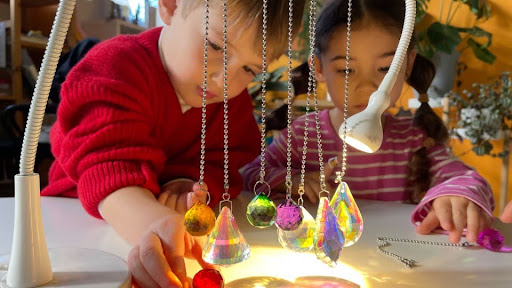
- Honoring the learning environment as an active teacher
- Documenting the creative learning process to ensure its visibility
- Coordinating pedagogical and educational practice as a group
- Family and caregiver participation in the educational community
No way. The hundred is there.
The child
is made of one hundred.
The child has
a hundred languages
a hundred hands
a hundred thoughts
a hundred ways of thinking
of playing, of speaking.
A hundred always a hundred
ways of listening
of marveling of loving
a hundred joys
for singing and understanding
a hundred worlds
to discover
a hundred worlds
to invent
a hundred worlds
to dream.
The child has
a hundred languages
(and a hundred hundred hundred more)
but they steal ninety-nine.
The school and the culture
separate the head from the body.
They tell the child:
to think without hands
to do without head
to listen and not to speak
to understand without joy
to love and to marvel
only at Easter and Christmas.
They tell the child:
to discover the world already there
and of the hundred
they steal ninety-nine.
They tell the child:
that work and play
reality and fantasy
science and imagination
sky and earth
reason and dream
are things
that do not belong together.
And thus they tell the child
that the hundred is not there.
The child says:
No way. The hundred is there.
Loris Malaguzzi (translated by Lella Gandini)
Invece il cento c’è.
Il bambino
è fatto di cento.
Il bambino ha
cento lingue
cento mani
cento pensieri
cento modi di pensare
di giocare e di parlare
cento sempre cento
modi di ascoltare
di stupire di amare
cento allegrie
per cantare e capire
cento mondi
da scoprire
cento mondi
da inventare
cento mondi
da sognare.
Il bambino ha
cento lingue
(e poi cento cento cento)
ma gliene rubano novantanove.
La scuola e la cultura
gli separano la testa dal corpo.
Gli dicono:
di pensare senza mani
di fare senza testa
di ascoltare e di non parlare
di capire senza allegrie
di amare e di stupirsi
solo a Pasqua e a Natale.
Gli dicono:
di scoprire il mondo che già c’è
e di cento
gliene rubano novantanove.
Gli dicono:
che il gioco e il lavoro
la realtà e la fantasia
la scienza e l’immaginazione
il cielo e la terra
la ragione e il sogno
sono cose
che non stanno insieme.
Gli dicono insomma
che il cento non c’è.
Il bambino dice:
invece il cento c’è.
Loris Malaguzzi
The Benefits of the Reggio Emilia Approach
The Reggio Emilia Approach results in self-confident, creative, expressive children, adolescents, and adults able to think critically and act independently.

Self-directed exploration
Reggio Emilia Approach students share ownership of their learning, working with teachers and atelieristas to guide activities and education. Doing so fosters confidence and healthy independence.

Strength in collaboration
Development of emotional intelligence and social skills leads to successful negotiation and collaboration — skills essential in today’s world.

Creative solutions
Unbounded exploration and in-depth inquiry leads students to think critically.

Community connection
Parents and extended community members join as partners in education, working within and alongside the educational environment to support development.

Rich expressiveness
Students keep their innate modes of communication alive to express themselves through art, sculpting, music, drama, physicality, and more.
About Reggio Children
Today, Reggio Children leads as proponents of the Reggio Emilia Approach and serves as an international center for the defense and promotion of children’s rights and their potential.
Reggio Children promotes and experiments with quality education, diffusing it around the world through professional development, professional learning, publishing, exhibitions, research, and more. The California International Reggio Center operates with the participation of Reggio Children.